Not an accident, not a tragedy, not a plan B
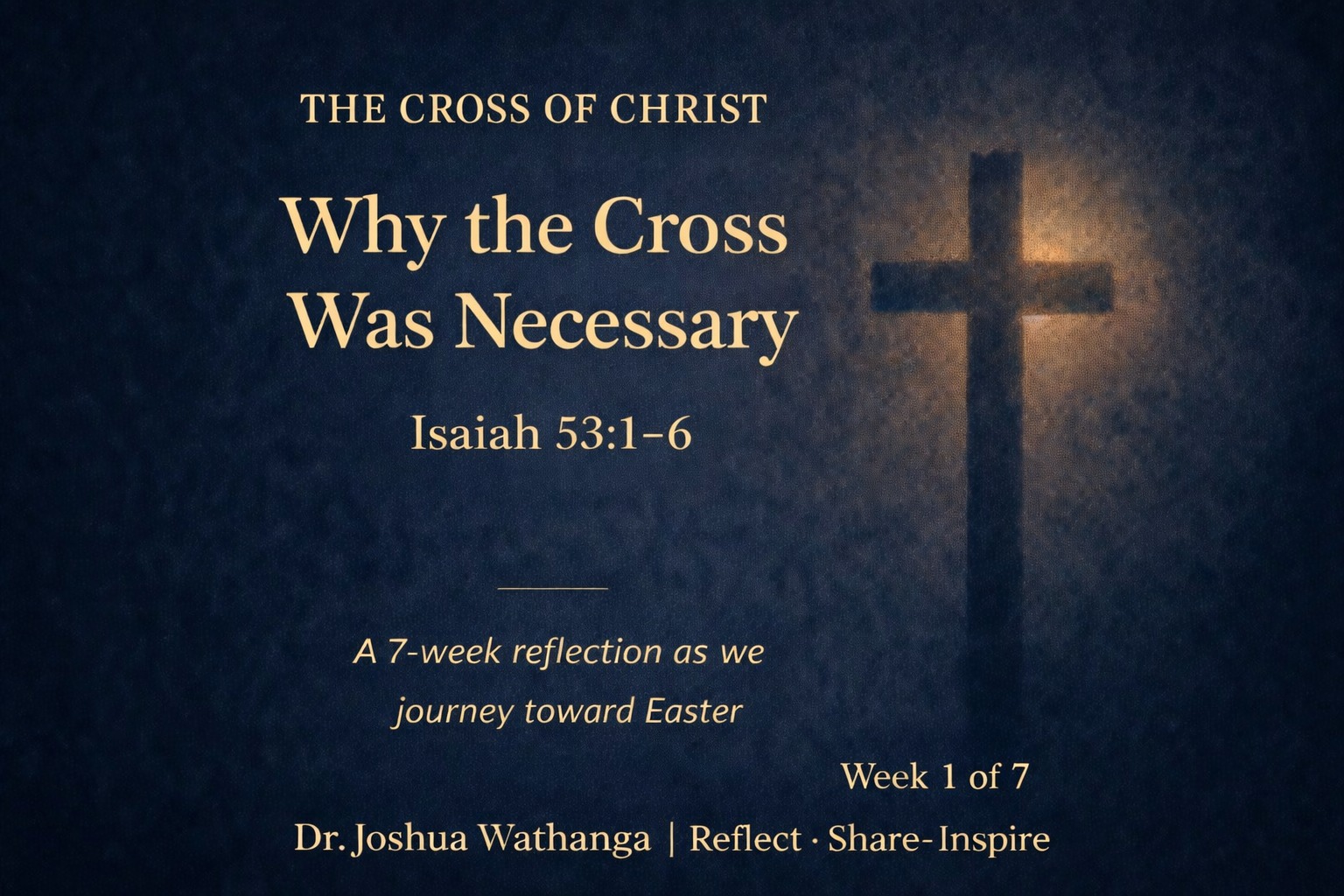
A reflection for the week as we journey toward Easter. Week 1
As we begin this journey toward Easter, the first question we must face is also the most basic. Why was the Cross necessary at all?
For many people, the Cross is assumed rather than examined. Jesus was betrayed, unjustly condemned, and cruelly executed. We recognise the injustice and lament the suffering. But if the Cross is only the tragic outcome of human cruelty, then it sits awkwardly at the centre of Christian faith. Tragedies may move us, but they do not save us.
The New Testament insists on something more unsettling and more profound. The Cross was not merely something done to Jesus. It was something Jesus willingly embraced. And more than that, it was something God Himself purposed.
To begin seeing this, we turn not first to the Gospels, but to an ancient prophetic text that has shaped Christian understanding of the Cross for centuries: Isaiah 53:1–6. This passage does not describe an unexpected turn of events. It speaks of suffering that is foreseen, misunderstood, and yet deeply purposeful. The figure Isaiah describes is rejected, despised, and acquainted with grief. He is not celebrated or recognised. Those who see him assume that his suffering is deserved, even divinely inflicted. They turn away.
But the prophet insists that this assumption is wrong.
Again and again, the text draws a sharp contrast between “we” and “he.” We misjudged. We assumed. We went astray. He bore. He carried. He was wounded. He was crushed.
The language is not accidental. Isaiah is not describing suffering in general, nor is he reflecting abstractly on human pain. He is pointing to a suffering that is vicarious, purposeful, and weight-bearing. “He was pierced for our transgressions,” the text says. “He was crushed for our iniquities.”
The suffering described here is not random. It is connected directly to the condition of others.
This is where the necessity of the Cross begins to come into focus.
If sin were merely a matter of human weakness or ignorance, then instruction or reform might suffice. If guilt could simply be set aside without consequence, then forgiveness could be casual. But Isaiah’s language refuses such simplicity. The problem being addressed is deeper. It involves estrangement, guilt, and a rupture that cannot be healed by goodwill alone.
The text reaches its stark clarity in verse 6. “We all, like sheep, have gone astray, each of us has turned to our own way; and the Lord has laid on him the iniquity of us all.” Here, necessity is not imposed by cruelty, but by reality. Something is wrong that cannot be ignored without denying truth. Something must be borne, not merely acknowledged. And Isaiah dares to say that the burden is laid upon another.
This is why the Cross cannot be understood as a tragic mistake, nor as an unfortunate detour in God’s plan. Long before Roman soldiers or religious leaders appear on the scene, Scripture is already shaping our imagination. The suffering servant does not stumble into suffering. He walks toward it.
Seen in this light, the Cross confronts us before it comforts us. It tells us that our condition is more serious than we like to admit. We are not merely victims of circumstance or products of broken systems. We are, in Isaiah’s words, wanderers who have turned to our own way.
At the same time, the Cross also reveals something astonishing about God. The Lord does not resolve the problem of sin by standing at a distance, issuing pardon from afar. Instead, He enters into the cost of forgiveness Himself. The burden is not ignored. It is carried.
This is why Christians have always insisted that the Cross was necessary. Not because God delights in suffering, but because God refuses to deny justice or abandon mercy. At the Cross, both are held together.
It is tempting to rush past this seriousness in order to reach Easter joy. But if we hurry too quickly, we will misunderstand both. Resurrection becomes shallow if the Cross is treated lightly. Hope becomes vague if we do not first face what hope has overcome.
As we begin this journey, the invitation is simple but demanding. We are asked to look steadily at the Cross and to let it tell us the truth, about ourselves, about God, and about the cost of reconciliation.
The Cross was not an accident.
It was not a tragedy that might have been avoided.
It was not a plan B.
It was the place where God chose to deal decisively with what separates us from Him, and to do so at His own expense.
To stand before that reality with honesty is the first step toward Easter.
Prayer
Lord Jesus Christ,
we stand again before Your Cross.
Give us eyes to see what You have done,
hearts to trust what You have accomplished,
and lives shaped by the grace that flows from it.
Keep us from treating the Cross lightly,
or leaving it behind too quickly.
Teach us to live under its shadow,
until faith gives way to sight.
Amen.
This post is part of a seven-week Easter journey titled The Cross of Christ: A Journey for Thoughtful Believers. Each week reflects on one aspect of the Cross, anchored in a single passage of Scripture, and written for fellow believers who want to think carefully, without jargon, about what Christ has done.
No responses yet