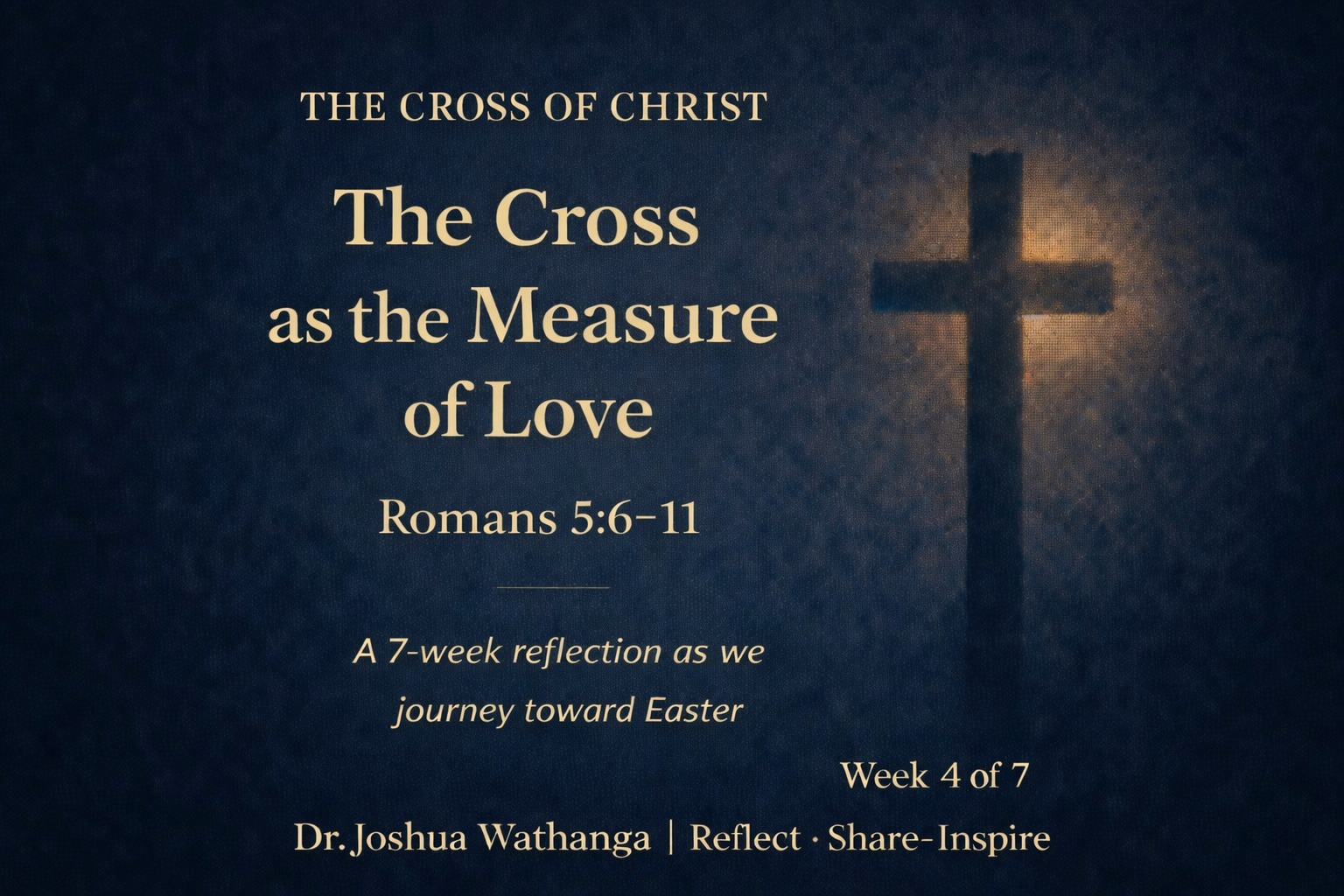
Why love at Calvary is neither soft nor vague
A reflection for the week as we journey toward Easter- Week 4
Few words are used more freely today than the word love. We apply it to people and preferences, to causes and comforts. We speak of love as affirmation, attraction, or emotional warmth. Much of this is understandable. Love matters. But when we carry these everyday meanings to the Cross, we risk misunderstanding what is being revealed there.
If the Cross is meant to show us love, then we must allow Scripture to define what kind of love it is.
For this week, we turn to Romans 5:6–11, a passage where the apostle Paul speaks with unusual clarity about love, not as sentiment, but as action with cost.
Paul begins with a startling description of the human condition. “While we were still weak,” he writes, “at the right time Christ died for the ungodly.” Love, in this passage, does not arise because we were strong, faithful, or deserving. It moves toward weakness. It addresses need rather than merit.
Paul then sharpens the contrast. It is rare, he says, for someone to die even for a righteous person, though for a good person someone might dare to die. We instinctively understand this. Sacrifice usually follows worth. We give ourselves for those we admire, those who belong to us, those who have earned our loyalty.
But Paul insists that the Cross breaks this pattern.
“God demonstrates His own love for us in this: while we were still sinners, Christ died for us.” Love at the Cross is not a response to goodness. It is an initiative toward rebellion. It does not wait for improvement. It moves first.
This is why the Cross refuses sentimental definitions of love. It does not portray love as indulgence or approval. It portrays love as costly commitment to the good of the other, even when that other is resistant or hostile.
Paul does not stop there. He goes on to say that we were not only sinners, but enemies. The language is strong and unsettling. It reminds us that sin is not merely a lapse or a misunderstanding. It involves opposition to God’s rightful claim on our lives. Love, in this context, is not merely healing. It is reconciling.
This is where the Cross holds together what we often separate. Love and justice meet here, not as rivals, but as companions. God does not choose to love us by abandoning righteousness. Nor does He uphold righteousness by withholding love. At the Cross, He does both.
This helps us see why love at Calvary is neither soft nor vague.
It is not soft because it takes sin seriously. Love does not deny the damage done by human rebellion. It confronts it. It names it. And it bears its cost.
It is not vague because it is anchored in a specific act. Love is demonstrated, Paul says, not merely declared. It takes shape in the death of Christ at a particular moment in history, for particular people, at real cost.
This challenges some of our assumptions. We often think of love as something that primarily affirms us as we are. The Cross tells us something deeper. Love affirms our worth by refusing to leave us unchanged. It moves toward us in our need, not to confirm our direction, but to restore us.
At the same time, the Cross rescues love from becoming harsh or conditional. God does not wait for us to become lovable. He loves in order to redeem. The initiative is His. The action is His. The cost is His.
Paul draws a quiet but powerful conclusion from this. If God loved us in this way while we were sinners and enemies, how much more can we trust His love now that we have been reconciled? Love at the Cross is not a one-time gesture. It establishes a relationship that endures.
This is where assurance begins to grow. If love depended on our consistency, it would always be fragile. If it depended on our obedience, it would always be uncertain. But if love is demonstrated at the Cross while we were still sinners, then it rests on God’s faithfulness, not ours.
To stand before the Cross is to be confronted by a love that does not flatter us, but does not abandon us either. It tells the truth about our condition and refuses to let that condition have the final word.
As we continue this journey toward Easter, the invitation this week is simple but searching. We are asked to let the Cross redefine love for us. Not as sentiment. Not as indulgence. But as self-giving commitment that bears the cost of reconciliation.
Only such love can heal. Only such love can be trusted. And only such love is worthy of worship.
Prayer
Lord Jesus Christ,
we stand again before Your Cross.
Give us eyes to see what You have done,
hearts to trust what You have accomplished,
and lives shaped by the grace that flows from it.
Keep us from treating the Cross lightly,
or leaving it behind too quickly.
Teach us to live under its shadow,
until faith gives way to sight.
Amen.
This post is part of a seven-week Easter journey titled The Cross of Christ: A Journey for Thoughtful Believers. Each week we reflect on one aspect of the Cross, each reflection anchored in a single passage of Scripture. They are written for fellow believers who want to think carefully, without jargon, about what Christ has done.
If you would like to read the reflections from the beginning, you can access them here:
Introduction to the Easter Series: The Cross of Christ, A Journey for Thoughtful Believers – https://joshuawathanga.com/the-cross-of-christ/
Week 1 : Why the Cross Was Necessary– https://joshuawathanga.com/why-the-cross-was-necessary/
Week 2: The Cross and the Problem of Sin – https://joshuawathanga.com/the-cross-and-the-problem-of-sin/
Week 3: The Cross and Substitution – https://joshuawathanga.com/%f0%9d%97%a7%f0%9d%97%b5%f0%9d%97%b2-%f0%9d%97%96%f0%9d%97%bf%f0%9d%97%bc%f0%9d%98%80%f0%9d%98%80-%f0%9d%97%ae%f0%9d%97%bb%f0%9d%97%b1-%f0%9d%97%a6%f0%9d%98%82%f0%9d%97%af%f0%9d%98%80%f0%9d%98%81/
No responses yet