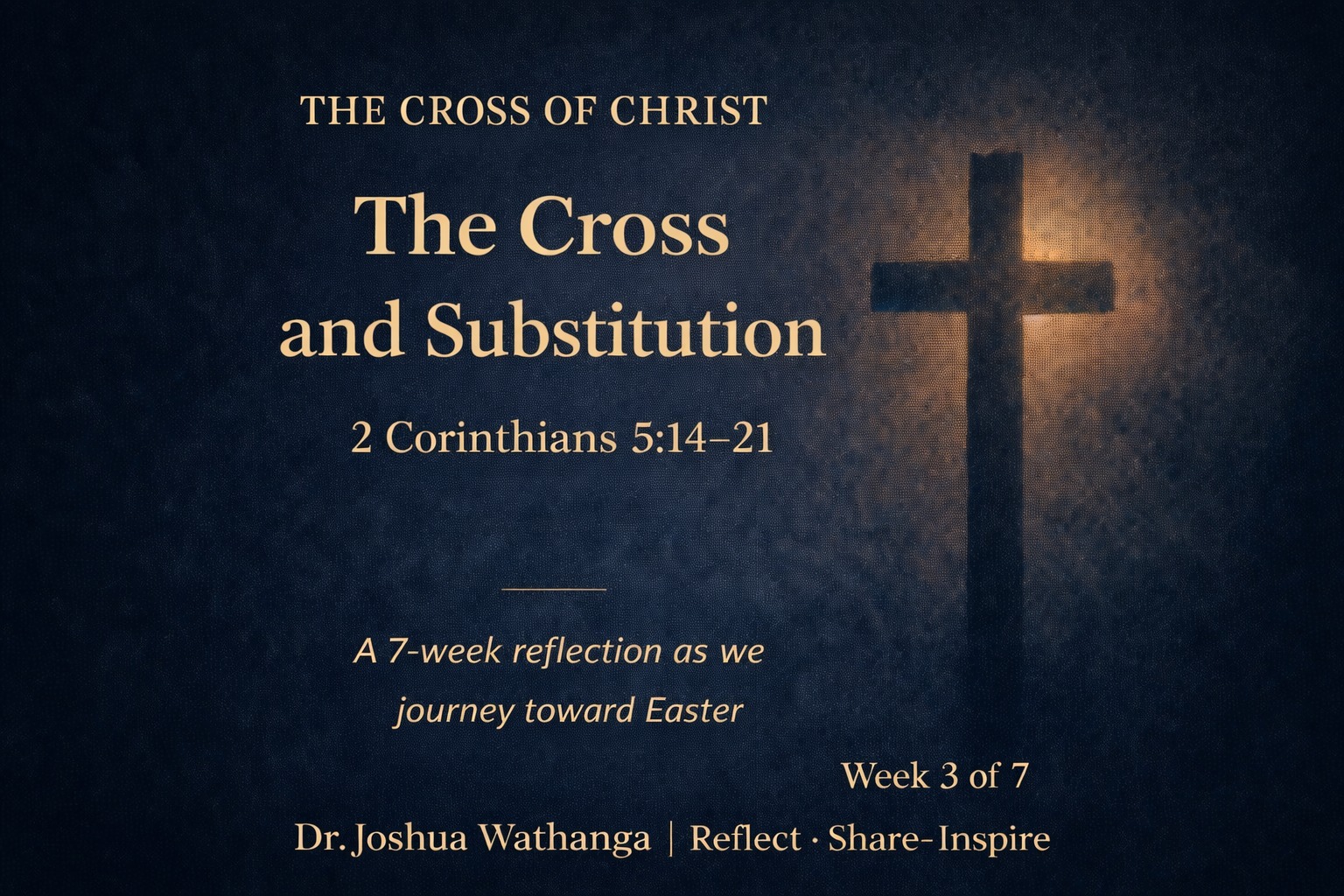
What Christians mean when they say, “for us”
A reflection for the week as we journey toward Easter – Week 3
We often say, “Jesus died for us.” The words roll easily off the tongue. We sing them in hymns and repeat them in prayers. Yet if we pause for a moment, an important question emerges: what does for us actually mean?
This question matters because substitution sits close to the centre of how Christians have understood the Cross. If it is misunderstood, the Cross can appear cruel, mechanical, or morally troubling. If it is avoided altogether, the Cross risks becoming little more than an inspiring example.
This week, we turn to 2 Corinthians 5:14–21, a passage where the apostle Paul speaks about substitution not as an abstract theory, but as the heart of reconciliation.
Paul begins with love, not punishment. “The love of Christ compels us,” he writes. What drives Paul’s understanding of the Cross is not divine anger looking for an outlet, but divine love moving decisively toward the lost. The Cross, in this passage, is first and foremost an act of love with purpose.
Paul then makes a striking claim: “One died for all, and therefore all died.” This is not merely poetic language. Paul is saying that Christ’s death is representative. Something happened in Christ’s death that involves others. The Cross is not only something we look at; it is something we are drawn into.
From there, Paul unfolds the meaning of substitution in relational terms. Christ dies so that those who live might no longer live for themselves, but for Him. The Cross creates a new way of belonging, a new orientation of life. Substitution is not simply about escaping consequences; it is about being brought into a restored relationship.
The heart of the passage comes near the end. “God made him who knew no sin to be sin for us, so that in him we might become the righteousness of God.” Few sentences in Scripture are as dense or as carefully balanced as this one. Paul does not say that Christ became sinful. He says that Christ, who was without sin, took upon Himself what belonged to us, so that we might receive what belongs to Him.
This is substitution, but not in crude or violent terms. It is not a picture of an unwilling Son punished by a harsh Father. Paul insists that this is God’s own action of reconciliation. “God was in Christ, reconciling the world to Himself.” The initiative belongs to God. The purpose is restoration. The cost is borne by God Himself.
Seen this way, substitution is not the opposite of love. It is the shape love takes when it refuses to ignore what is wrong. Love does not pretend that sin has no consequences. Love absorbs the cost of putting things right.
This helps us avoid two common misunderstandings.
The first is the idea that substitution turns the Cross into a cold transaction. Paul’s language resists this. The Cross is deeply personal. It is about being known, reconciled, and entrusted with a new identity. We are not merely acquitted; we are restored.
The second misunderstanding is the fear that substitution portrays God as divided against Himself. Paul allows no such division. God does not send someone else to do what He is unwilling to do. God Himself acts in Christ. The one who bears the cost is the one who loves.
Substitution, then, is not about shifting blame to an innocent third party. It is about God stepping into the place where judgment, guilt, and estrangement converge, and dealing with them from within. That is why Paul can speak of reconciliation with such confidence. The barrier is not ignored. It is removed.
This has profound implications for how we see ourselves. If Christ has acted for us in this way, then our standing before God does not rest on our performance, our consistency, or our spiritual maturity. It rests on what has already been done. We are invited to trust, not to supplement.
At the same time, substitution reshapes how we live. Paul says that those who are reconciled are given “the ministry of reconciliation.” Having been restored, we are sent. The Cross does not produce passivity. It produces gratitude, humility, and a new orientation toward others.
To stand before the Cross and say “He died for us” is to confess both our need and God’s generosity. It is to admit that we could not reconcile ourselves, and to rejoice that God has done so at His own expense.
Substitution does not diminish love. It reveals how far love is willing to go.
Prayer
Lord Jesus Christ,
we stand again before Your Cross.
Give us eyes to see what You have done,
hearts to trust what You have accomplished,
and lives shaped by the grace that flows from it.
Keep us from treating the Cross lightly,
or leaving it behind too quickly.
Teach us to live under its shadow,
until faith gives way to sight.
Amen.
This post is part of a seven-week Easter journey titled The Cross of Christ: A Journey for Thoughtful Believers. Each week reflects on one aspect of the Cross, anchored in a single passage of Scripture, and written for fellow believers who want to think carefully, without jargon, about what Christ has done.
If you would like to read the reflections from the beginning, you can access them here:
Introduction to the Easter Series: The Cross of Christ:
Introduction to the Easter Series: The Cross of Christ, A Journey for Thoughtful Believers – https://joshuawathanga.com/the-cross-of-christ/
Week 1 : Why the Cross Was Necessary– https://joshuawathanga.com/why-the-cross-was-necessary/
Week 2: The Cross and the Problem of Sin – https://joshuawathanga.com/the-cross-and-the-problem-of-sin/
No responses yet